Breaking — the capital moves defining 2026
Breaking — the capital moves defining 2026
Breaking — the capital moves defining 2026
Drones raised 60 times more than ground robotics
European defence drone companies raised $4.7bn this year. Ground robotics raised $77.6m. The gap says less about the companies than about how each one is financed.
In this story
What the numbers actually measure
3 companies, 3 routes to capital
Why ground autonomy attracts a different kind of capital
What this means for mapping the market
European defence technology raised money at 2 very different speeds this year. Drone companies took $4.7bn across 40 rounds. Ground robotics companies took $77.6m. On Dealroom’s figures through 20 September, that is a gap of roughly 60 times.
Read quickly, that looks like a verdict on the technology. Read properly, it is a statement about financing structure. Europe is not short of companies building uncrewed ground systems. It is short of companies financing them the way drone businesses do.
The distinction matters for anyone trying to size this market, because most of the capital going into ground autonomy is invisible to anyone counting venture rounds.
What the numbers actually measure
$4.7bn across 40 rounds describes a mature venture category. It implies a repeatable pattern: identifiable companies, priced rounds, syndicates able to follow on, and enough comparable transactions for investors to benchmark one deal against another.
$77.6m does not describe a sector that failed to attract capital. It describes a sector where most of the capital did not arrive as a venture round, and so was never counted.
Dealroom tracks disclosed venture financing. Majority acquisitions, strategic stakes and undisclosed purchase prices sit outside that frame. In ground robotics, those are not edge cases. They are the main route.
3 companies, 3 routes to capital
The most visible European ground robotics businesses have each been financed differently, and only 1 of them appears cleanly in the venture data.
ARX Robotics (Munich) raised a €31m Series A in 2025, led by HV Capital, with an €11m extension taking the total to €42m. This is the conventional route, and the only one of the 3 that a venture database captures in full.
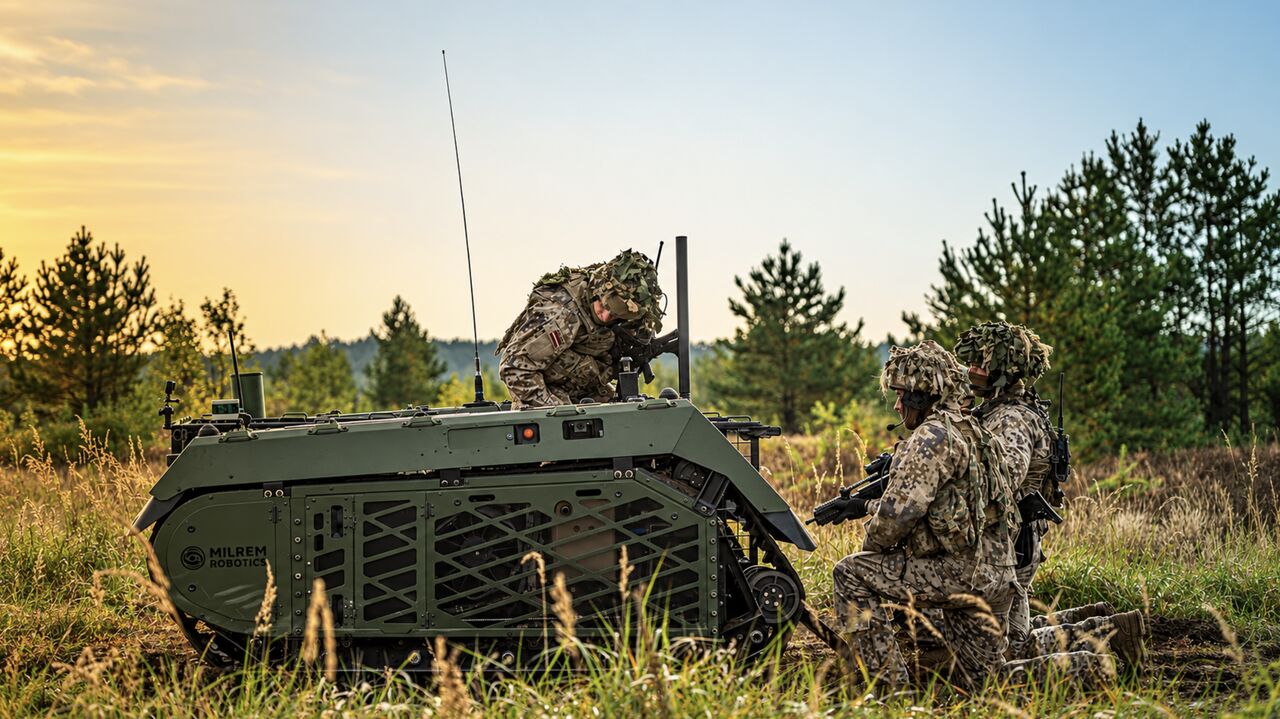
Milrem Robotics (Estonia) built THeMIS into a platform now in service or in robotics programmes across 19 countries. EDGE Group acquired a majority stake in 2023. The European Commission subsequently reviewed Milrem’s eligibility for EU defence programmes and allowed it to continue under Estonian guarantees.
DOK-ING (Croatia) passed to Rheinmetall, which completed its acquisition of a 51% stake this year. The purchase price was not disclosed, so the transaction contributes nothing to any funding total.
2 of the 3 were financed by being bought.
Why ground autonomy attracts a different kind of capital
The asymmetry is not arbitrary, and it is worth being precise about why it exists.
An uncrewed ground vehicle is a heavy industrial product. It needs manufacturing capacity, vehicle integration, field sustainment and a support chain that can follow a unit into deployment. That cost base sits more naturally inside an established defence group than on a venture balance sheet, and it rewards an owner that already holds the production lines and the customer relationships.
Drones compress that problem. Shorter production cycles, lower unit costs, faster iteration, and a procurement environment that has been willing to buy at volume and at pace. Those are the conditions venture capital is built for, which is why 40 rounds were available to count in the first place.
The Milrem case also shows what strategic ownership can cost. A majority sale to a non-EU acquirer triggered a review of the company’s eligibility for EU defence programmes, resolved through Estonian guarantees. Capital arrived, and a sovereignty question arrived with it, which a venture round would not have raised.
What this means for mapping the market
Build a picture of European ground autonomy from funding tables alone and you will conclude the sector is marginal. The companies above suggest otherwise.
The more useful question is not whether Europe is building ground systems, but who is financing them and on what terms. Venture rounds, majority acquisitions and strategic stakes are not interchangeable. They imply different owners, different time horizons, different exit expectations and, as Milrem shows, different regulatory exposure.
Track the acquisitions and the strategic stakes alongside the rounds. In this part of the market, the undisclosed transactions are where most of the capital sits.
Supply Chain
Funding Rounds

Written by
Dimeet Singh
Dimeet heads the firm's UAE and Gulf practice, working with family offices, private equity and institutional lenders deploying capital across borders.
Related stories


